
Waterwise Flip Side Chastetree for Pollinators
August 6, 2026
Heat & Drought Tolerant Tree that Brings the Pollinators!
You may be familiar with the ongoing saga of PINK flowering plants I've inherited on my new Oregon forest farm. Well, I was DELIGHTED to discover that the last owner did plant a few new plantings and the best of those plant choices has turned out to be two Flip Side® Chastetree (Vitex x 'Bailtexone' PP30,283). This hybrid Vitex was released in 2019 BUT these are the first two specimens I've actually see planted in a landscape.
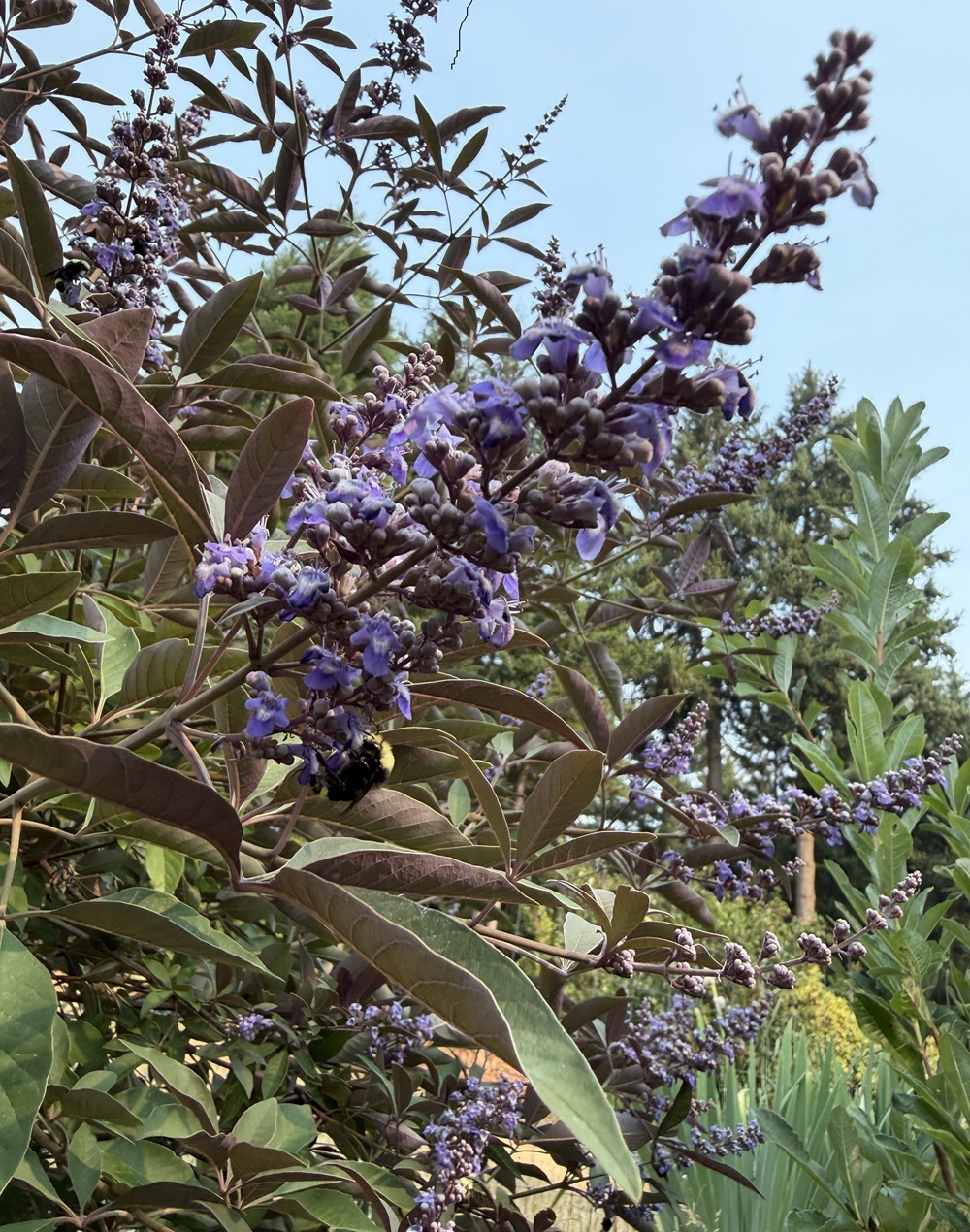
Close up of Vitex Flip Side floweres and foliage
PC: Leslie F. Halleck
Foliage & Flower Interest
Vitex are one of my favorite trees to plant in Texas and they grow wonderfully in Mediterranean type climates with hot dry summers. Good think that Oregon has similar summers, albeit not as hot. But I was so pleased to see Vitex growing and blooming beautifully this summer in my area.
There are different species of Vitex; some small woody trees and some low growing creeping species. The tree types are commonly referred to as chastetree. I'm so enamored by the bounty of usually blue flowers that go all summer. Flip Side® Chastetree, however, sports more lavender to purple colored blooms AND the bonus of purple foliage color on the undersides of leaves and stems. The color combo really makes this plant a standout in the landscape.
Chastetree attact TONS of pollinators, including many species of bees and butterflies.
Heat & Drought (and Deer) No Problem!
One of the reasons I love chastetree so much is that it thrives in very tough climates, both hot and dry all summer. Just when many of your other plants and trees are showing summer stress, chastetree comes into full fabulous bloom.
Plants are categorized as low water use (once established of course) make chastetree a good waterwise choice when cutting back on water use.
While chastetree isn't native to the U.S., it is very well suited to many areas across USDA zones 7-9, and up to Heat Zone 9.
And guess what? Plants are DEER RESISTANT. And yes, I can personally confirm this. I have LOTS of deer (mammas and babies) traversing my property looking for dinner and they've never touched these plants).
Size & Spacing
Now, having worked and gardened in Texas, which has a very long - almost year-round - growing season, I've learned that the max plant height and width on plant labels can't always be counted on. If you live somewhere with a long growing season, you can usually expect plants to get a bit taller and wider than the marketing information provided. Typical chastetree in Texas, and here in Oregon, typically reach closer to 15-feet, sometimes 20-feet, but this cultivar claims a shorter habit.
- Height 6'-8
- Width 8'-10'
- Arching habit
- Full Sun
It looks to me that my two specimens were probably planted just about 2-3 years ago, and they are about 3-4 feet tall right now. So we shall see how big they eventually grow! In any case, they will be stunning I'm sure.
So far I'm impressed with this colorful cultivar; if you're looking for a summer-tough booming small tree to support pollinators in your yard see if you can find Flip Side!
(Note: Flip Side is the trade marketing name for this cultivar. The botanical name is Vitex x 'Bailtexone' and the patent # is PP30,283.)